Resolving Excessive Oil Consumption and Turbocharger Failure in a Land Rover 2.2L Diesel Engine
Engine Replacement & Restoration
Executed by RR4X4Works certified master technicians with OEM-standard verification.
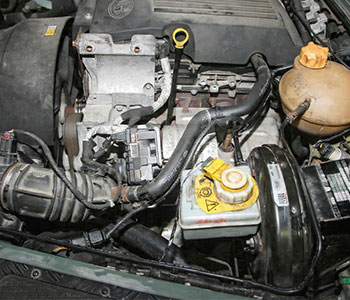
Vehicle Details
Land Rover 2.2 Diesel Engine Turbocharger Oil Seal Failure Repair
The owner arrived after searching Google for: “Land Rover 2.2 diesel burning oil, blue smoke on acceleration, loss of power – turbo gone?”
The vehicle’s specific problem was a combination of performance loss and oil consumption: significant blue-grey smoke from the exhaust under acceleration, a noticeable loss of mid-range power and turbo boost, and the engine consuming excessive engine oil (over 1 litre per 1000 miles). The owner’s primary concern was the rising cost of oil top-ups and the fear of a total turbo failure leading to a much larger repair bill.
Our Diagnostic Process: Finding the Root Cause in the Land Rover 2.2 Diesel
Excessive oil burning with blue smoke and power loss in a turbo diesel points toward a handful of critical failures that require methodical isolation.
- Initial Visual & Pressure Checks: We inspected for obvious external oil leaks, particularly around the turbocharger oil feed and return lines, and the intercooler hoses, which were oily to the touch – a first clue. A boost pressure leak test (smoke or pressure test of the intake system) was performed to rule out unmetered air as the primary cause of power loss.
- Diagnostic Scan for Overboost/Underboost: Using a generic OBD-II scanner capable of reading live data, we checked for fault codes related to the turbocharger and exhaust gas recirculation (EGR) system. Common codes like P0299 (Turbo/Supercharger Underboost) or those related to the Variable Geometry Turbo (VGT) actuator were present. Monitoring live data showed actual boost pressure significantly below specified boost.
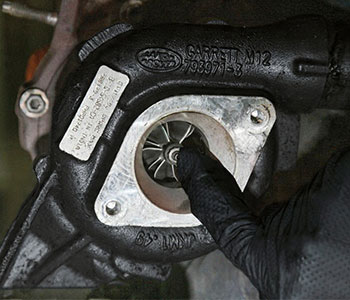
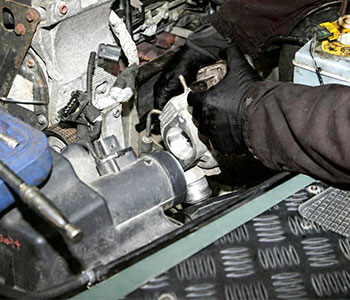
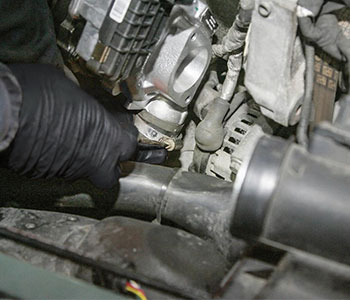
- Turbocharger Shaft Play Inspection: The most critical mechanical test. We removed the intake pipe leading to the turbocharger compressor inlet. By manually feeling the compressor wheel shaft, we could check for excessive radial (side-to-side) and axial (in-and-out) play. In this case, there was noticeable radial play and slight axial movement, indicating worn turbine shaft bearings.
- Intercooler & Pipe Inspection: We removed the lower intercooler hose. A significant pool of liquid engine oil was present in the intercooler and the intake pipes downstream of the turbo. This is definitive proof that oil is being forced past seals in the turbocharger and into the intake tract, where it is then burned in the engine, causing the blue smoke.
The Critical Factor Often Overlooked
A common response to a smoky, oil-burning diesel is to suspect worn piston rings or valve stem seals. While these can fail, on a modern turbo diesel with sudden oil consumption and power loss, the turbocharger is the prime suspect. Replacing piston rings is an engine-out, multi-thousand-pound repair. Replacing the turbocharger is a targeted, logical first step based on the evidence. Misdiagnosing this can lead to an unnecessary and devastatingly expensive engine rebuild that doesn't solve the problem.
The Root Cause Explained
In this 2.2L turbo diesel, the root cause is the failure of the turbocharger's central cartridge oil seals. The turbo shaft spins at over 150,000 RPM on a thin film of oil. The seals are designed to keep this oil inside the bearing housing. Over time, due to heat cycling, carbon buildup from exhaust gases, or infrequent oil changes, the shaft bearings wear. This wear creates imbalance and allows the shaft to move microscopically (shaft play), which rapidly degrades the delicate oil seals. Once compromised, pressurized engine oil leaks past the seals into both the compressor side (feeding oil into the intake) and the turbine side (burning oil in the exhaust). Think of it like the seal on a high-speed blender's rotating shaft. If the bearings wear, the shaft wobbles, shreds the seal, and the smoothie (engine oil) leaks out into the motor and the food (intake air).
Our Repair Strategy: The Most Comprehensive Solution for Long-Term Reliability
Upon confirming turbocharger failure with oil contamination, the effective options are:
- Turbocharger Clean/Repair Kit: Attempting to disassemble, clean the variable vanes (if applicable), and fit a generic seal/bearing repair kit.
- Potential Outcome: Very low parts cost. May reduce smoking temporarily if vanes were just stuck.
- Long-Term Consideration: Extremely high risk. These kits rarely address the core wear in the bearing housing. The repaired turbo often fails again within a short period due to imbalance or unseen housing wear, contaminating the engine with metal debris. The labour cost is wasted.
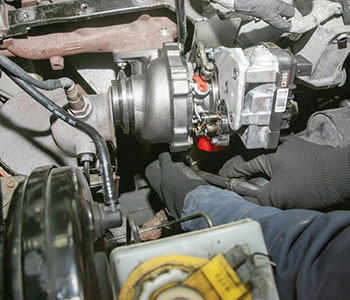
- Replacement with a Quality Reconditioned or New Turbo Unit (Our Chosen Strategy): Removing the failed unit and installing a complete, balanced turbocharger assembly from a reputable source.
- Why This Was the Most Comprehensive Choice: This is the only strategy that reliably addresses the failure at the component level. A quality reconditioned unit has a new bearing cartridge, balanced rotating assembly, and new seals, effectively giving you a "new" turbo. It comes with a warranty and, when paired with a full system clean, provides a predictable, long-term solution.
Our Detailed Repair Procedure:
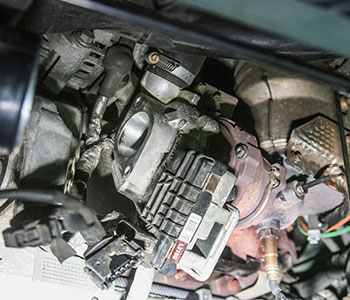
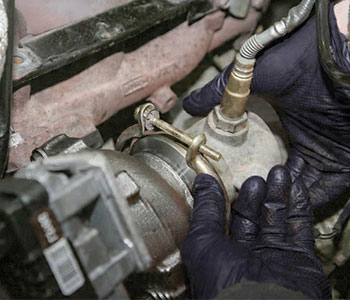
- Turbo & System Removal: The turbocharger was carefully unbolted from the exhaust manifold and downpipe. The oil feed and coolant lines (if water-cooled) were disconnected.
- Critical System Cleaning: We removed and thoroughly cleaned the intercooler and all associated intake pipes of accumulated oil. This is a mandatory step; failing to do so will cause the new turbo to draw in and burn residual oil, leading the customer to believe the repair has failed.
- Installation of New Components: We installed:
- A quality reconditioned turbocharger from a trusted UK specialist, including new gaskets and bolts.
- A new turbocharger oil feed line (the old one often has carbon blockages and degraded inner lining).
- A new genuine oil filter and full synthetic engine oil.
- Priming & Verification: Before starting the engine, we pre-lubricated the new turbo by cranking the engine with the fuel pump disabled to build oil pressure. Once started, we allowed for a careful cool-down idle period after the first test drive to prevent coking of oil in the new, hot turbo bearings.
Results & "Before/After" Proof
- Smoke: The blue exhaust smoke under acceleration was completely eliminated.
- Oil Consumption: Normal oil consumption resumed The (minimal top-up required between services).
- Performance: Full turbo boost pressure and power were restored. The vehicle pulled strongly through the rev range.
- Fault Codes: All under boost and turbo-related fault codes were cleared and did not return.
Summary:
- Core Problem: Excessive oil consumption and power loss due to failed turbocharger shaft seals and bearing wear.
- Solution: Replacement of the turbocharger with a reconditioned unit, comprehensive cleaning of the intercooler and intake system, and replacement of the oil feed line.
- Outcome: Eliminated oil burning, restored full engine performance and boost, and protected the engine from further oil contamination.
Verified Customer Review
— Gareth P., Devon
“My Discovery was becoming a smoke machine and felt sluggish. I was worried it needed a full engine rebuild. RR4x4 Works checked the turbo shaft, found it was loose, and showed me all the oil in the intercooler pipes. Their explanation that a new turbo was the logical first and most likely fix made perfect sense. They cleaned everything out properly and now it runs like new, with no smoke and plenty of power. A clear, honest diagnosis that saved me from a much bigger bill.”
Read More ↑Concerned About a Similar Issue? Get a Professional Diagnosis
Blue smoke and oil consumption in a turbo diesel are urgent warnings. Continuing to drive can lead to catastrophic turbo failure, sending debris into the engine. For a definitive diagnosis, contact RR4x4 Works for a turbo and intake system inspection.
Get Free Quote Call 01708 556 721