Resolving Turbocharger Failure Caused by a Blocked Oil Feed Line in a Land Rover 2.7L TDV6 Engine
Engine Replacement & Restoration
Executed by RR4X4Works certified master technicians with OEM-standard verification.
Vehicle Details
Land Rover 2.7 TDV6 Turbocharger Failure from Oil Starvation
The owner arrived after searching Google for: “Discovery 3 lost power while driving, loud whistling/screeching from engine, now white smoke – turbo blown?”
The vehicle’s specific problem was a sudden turbocharger failure: during motorway driving, the owner reported a sudden and complete loss of power, accompanied by an extremely loud, high-pitched whistling or screeching noise from the engine bay. Immediately after, dense white/grey smoke poured from the exhaust. The vehicle would start and idle, but pressing the accelerator produced zero boost, excessive smoke, and no power. The owner’s primary concern was understanding whether the engine was safe to drive and the extent of potential collateral damage beyond the obvious turbo failure.
Our Diagnostic Process: Finding the Root Cause in the Land Rover 2.7 TDV6
A sudden turbo failure with these symptoms requires immediate diagnosis to prevent secondary engine damage from oil loss or debris ingestion.
- Immediate Safety & Visual Inspection: The first step was a visual inspection of all turbocharger air and oil lines. We found the intercooler hose on the driver's side had blown off its connection, a common immediate result of a sudden over-pressure event from a turbo failure. The turbocharger oil feed and return lines showed signs of extreme heat (baking and discoloration).
- Diagnostic Scan for Boost Pressure: Using an advanced OBD-II scanner with manufacturer-specific capabilities, we read live data. The key parameter was "Boost Pressure (specified vs. actual)." The data showed the ECU was demanding full boost (approx. 1.8 bar), but the actual measured boost was 0 bar, confirming a total failure of the boost pressure system.
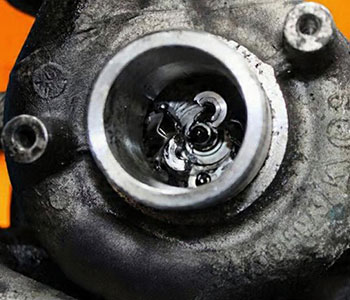
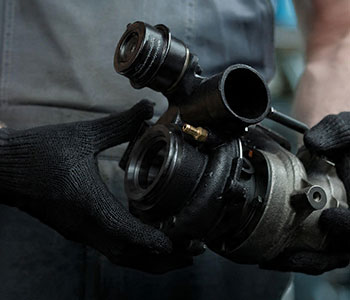
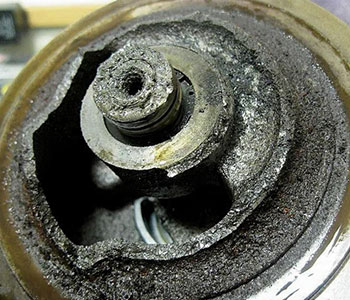
- Turbocharger Shaft Play & Physical Inspection: We removed the intake pipe to the driver's side (LH) turbocharger. Manual inspection revealed extreme axial (in/out) shaft play—over 3mm—and the compressor wheel showed visible contact marks with the housing, confirming catastrophic bearing failure. The turbine wheel on the exhaust side was also found to be damaged upon further disassembly.
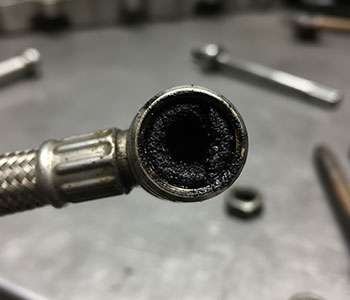
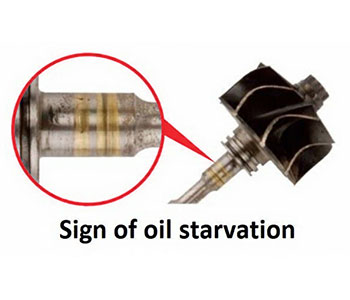
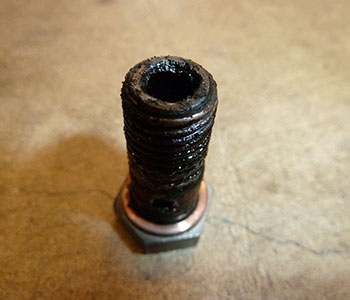
- Critical Step: Oil System Investigation: Recognizing that sudden, catastrophic turbo failure rarely occurs without cause, we focused on the oil supply. We removed the turbocharger oil feed line and attempted to blow air through it. The line was completely blocked by a solid, carbonized sludge. This blockage starved the turbo of lubrication, causing the bearings to seize and the shaft to break.
The Critical Factor Often Overlooked
The standard repair for a blown turbo is to simply replace the turbo unit. However, without identifying and rectifying the root cause of the turbo's oil starvation, the new turbo is condemned to the same rapid, destructive failure. The blocked oil feed line is the disease; the broken turbo is the symptom. Simply treating the symptom guarantees a costly repeat failure, often within a few hundred miles, as the new turbo's bearings will also be starved of oil.
The Root Cause Explained
In this TDV6, the root cause was the complete occlusion (blockage) of the turbocharger oil feed line by carbonized oil deposits. This occurs due to infrequent oil changes, the use of incorrect or low-quality engine oil, or excessive engine heat cycles causing oil to "coke" or bake into a hard carbon inside the narrow feed line. The turbocharger shaft spins at over 150,000 RPM and is lubricated and cooled solely by a constant flow of clean, pressurised oil. When this flow is blocked, friction heat in the bearings skyrockets within seconds. The bearings weld themselves to the shaft (seizure), the rotating assembly grinds to a halt, and the still-spinning turbine wheel, driven by exhaust gases, is torn apart. Think of it like a high-speed dental drill (the turbo) that must have water (oil) flowing through it to cool it. If the water line is blocked by limescale (carbon), the drill bit overheats, melts its bearings, and shatters.
Our Repair Strategy: The Most Comprehensive Solution for Long-Term Reliability
With a seized turbo caused by a blocked oil line, the repair must be holistic:
- Turbo-Only Replacement: Swapping in a new or reconditioned turbocharger.
- Potential Outcome: May restore power temporarily.
- Long-Term Consideration: Guaranteed to fail again, and quickly. Installing a new turbo on a starved oil system is a complete waste of a costly component and the labour to fit it. It ignores the primary failure.
- Turbo Replacement with Full Oil System Decontamination (Our Chosen Strategy): Replacing the turbocharger, the blocked oil feed line, and performing a complete engine oil system flush to remove all carbon deposits from the oil galleries, cooler, and sump.
- o Why This Was the Most Comprehensive Choice: This is the only strategy that surgically removes the failure's cause and effect. It addresses the three critical points: 1) The destroyed component (turbo), 2) The blocked delivery system (feed line), and 3) The contaminated source (the engine's oil system). This ensures clean, unobstructed oil flow to the new turbo, giving it the same lifespan as a factory-fresh installation.
Our Detailed Repair Procedure:
- Oil System Draining & Flushing: Before any disassembly, we performed a two-stage chemical flush of the entire engine oil system using a dedicated engine flush product, followed by draining all oil.
- Component Replacement: We then installed:
- A high-quality, reconditioned turbocharger assembly for the affected bank, complete with new gaskets.
- Brand new, Genuine Land Rover turbocharger oil feed and return lines for both turbochargers (as both lines are the same age and subject to the same coking risk).
- A new oil cooler (a common point for carbon accumulation).
- Systematic Reassembly & Priming: After installation, we pre-lubricated the new turbo by cranking the engine with the fuel pump disabled to circulate clean oil and establish pressure before the first start. We then followed a strict cool-down procedure after the initial run to prevent oil coking in the hot, new turbo.
Results & "Before/After" Proof
- Noise & Smoke: The loud screeching noise and excessive exhaust smoke were completely eliminated.
- Performance: Full boost pressure and engine power were restored to factory specification. Live data showed specified and actual boost pressures matching correctly.
- Oil Pressure & Health: Oil pressure remained stable. A follow-up oil change and analysis at 500 miles showed no abnormal contaminants or metal particles, confirming a clean system.
- Reliability: The vehicle was returned with confidence, having had the failure chain completely broken.
Summary:
- Core Problem: Catastrophic turbocharger seizure due to oil starvation from a completely blocked oil feed line.
- Solution: Replacement of the turbocharger and both oil feed/return lines, coupled with a complete engine oil system flush and new oil cooler.
- Outcome: Restored forced induction performance with a clean, reliable oil supply system, preventing repeat failure.
Verified Customer Review
— Raj P., Leicester
“When my turbo exploded on the M1, the recovery driver said ‘just needs a new turbo.’ RR4x4 Works found the real problem: a solid, blocked oil pipe. They explained that just bolting on a new turbo would have been like fixing a burst pipe without turning off the water main. Flushing the whole system and replacing all the lines made total sense. It wasn't the cheapest quote, but it was the only one that explained the why. The car now drives perfectly, and I know it won't happen again next week.”
Read More ↑Concerned About a Similar Issue? Get a Professional Diagnosis
A sudden loss of power accompanied by a loud whistling or screeching noise is a turbocharger emergency. Driving further can cause complete oil loss or ingest turbo fragments into the engine. Contact RR4x4 Works immediately for a diagnosis that traces the problem to its source.
Get Free Quote Call 01708 556 721