Resolving Severe Timing Chain Rattle and Guide Failure in a Land Rover 4.4L V8 Petrol Engine
Engine Replacement & Restoration
Executed by RR4X4Works certified master technicians with OEM-standard verification.
Vehicle Details
Land Rover AJ-V8 4.4L Engine Timing Chain Guide Failure Repair
The owner arrived after searching Google for: “Range Rover L322 4.4 V8 loud rattling noise on cold start – sounds like marbles in a can?”
The vehicle’s specific problem was severe timing chain noise: an extremely loud, rapid metallic rattling or “clattering” noise from the front/top of the engine that lasted for 3-7 seconds after a cold start, often described as sounding like marbles being shaken in a tin can. The noise would sometimes diminish but not fully disappear once warm, becoming a persistent, quieter rattle at certain RPMs. The owner’s primary concern was the fear of imminent, catastrophic engine damage (like the chains jumping time and destroying valves) and the daunting complexity of a V8 engine repair.
Our Diagnostic Process: Finding the Root Cause in the Land Rover 4.4 V8
Diagnosing chain noise on this V8 requires isolating which of the four timing chains is affected and assessing the condition of the complex guide system.
- Stethoscope Localisation: Using a mechanical stethoscope, we carefully listened to different areas of the front timing cover. The noise was often loudest on the upper passenger side (bank 2) or driver side (bank 1), helping to isolate the problem to a specific bank of cylinders. This engine has primary chains for each bank and secondary chains for the camshafts.
- Fault Code & Live Data Analysis: Using the Jaguar Land Rover specific diagnostic tool (SDD/IDS), we checked for fault codes. While not always present, codes such as P0011/P0021 (Camshaft Position Timing Over-Advanced) can appear. More importantly, we monitored live camshaft adaptation values. Excessive positive correction values (often above +8°) on one bank confirmed the ECU was struggling to maintain correct timing due to physical chain stretch on that side.
- Oil Pressure Test (Critical): We performed a mechanical oil pressure test. The hydraulic tensioners that take up chain slack are entirely dependent on strong, immediate oil pressure on startup. Low or slow-building oil pressure at a hot idle can indicate a worn oil pump or excessive bearing clearance, which directly contributes to tensioner failure and chain slap.
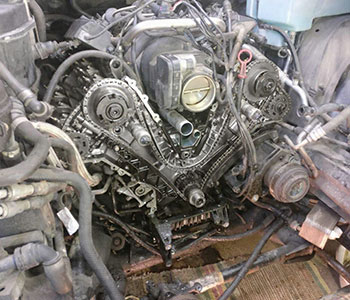
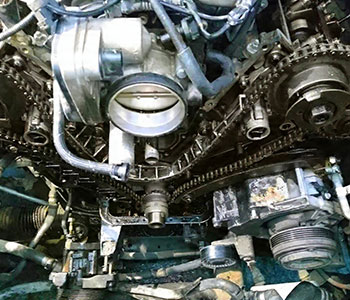
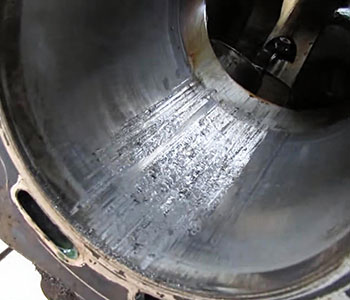
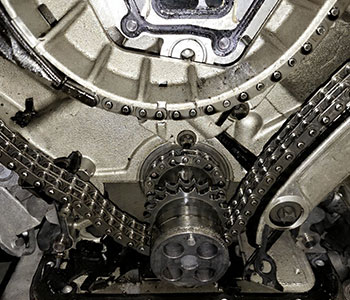
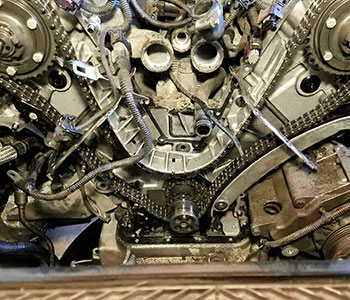
- Visual Inspection (Upon Cover Removal): While this is part of the repair, the diagnosis is confirmed upon disassembly. Failed guides are visibly broken or deeply grooved, and the plastic tensioner pads are often completely worn away, leaving the metal arm to contact the chain directly.
The Critical Factor Often Overlooked
A common approach for a persistent V8 rattle is to replace only the obviously failed components found—perhaps the broken guide on one bank. However, this engine’s timing system is a unified assembly under identical stress and age. The plastic guides and tensioner pads on the opposite bank, while not yet broken, are just as old and brittle. Replacing only the visibly broken parts is a high-risk strategy, as the remaining original guides can fail soon after, requiring the same expensive labour charge to open the engine a second time.
The Root Cause Explained
In the AJ-V8 4.4L engine, the root cause is the material fatigue and failure of the nylon/plastic composite timing chain guide rails and tensioner pads. These components are in constant, slight contact with the moving chains. Over time and heat cycles, the plastic becomes brittle and cracks. Once a guide cracks or a tensioner pad wears through, the metal chain begins to slap directly against the remaining plastic or the aluminium timing cover itself, creating the severe rattle. The hydraulic tensioners can also wear internally, failing to maintain consistent pressure. In simple terms, imagine a bicycle chain running over a plastic guide wheel. If the plastic wheel cracks and falls apart, the metal chain starts whipping against the metal frame, making a terrible racket and quickly destroying itself.
Our Repair Strategy: The Most Comprehensive Solution for Long-Term Reliability
Faced with timing chain guide failure, the owner’s options are defined by the need to access the front of the engine:
- Partial Kit Replacement ("While You're In There"): Replacing only the broken guides and the chains on the affected bank.
- Potential Outcome: Solves the immediate, loudest noise.
- Long-Term Consideration: High risk of a return visit. The guides, tensioners, and chains on the other bank are of identical age and material. It is highly probable they will fail in the near future, requiring another complete disassembly and labour bill.
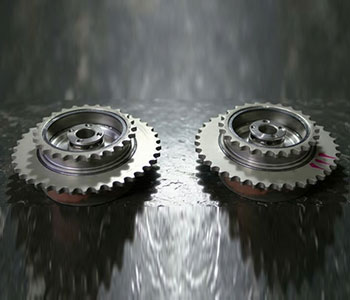
- Complete Timing System Overhaul (Our Chosen Strategy): Replacing every timing component for both cylinder banks during a single repair session. This includes all four chains, all guide rails, all four hydraulic tensioners, the idler sprockets, and the crank sprocket.
- Why This Was the Most Comprehensive Choice: This strategy applies the principle of preventive system renewal during major access. Since the labour to remove the front cover, radiator, and ancillaries is the most significant cost, replacing the entire timing system resets its service life to zero. It eliminates the risk of a near-future repeat failure and provides the customer with a single, definitive repair and a long-term warranty.
Our Detailed Repair Procedure:
- Front-End Access: The cooling system is drained, and the radiator, fan, and ancillary belts are removed to access the large front timing cover.
- System Locking & Disassembly: The engine is set to Top Dead Centre (TDC) using locking pins. The timing cover is removed, revealing the timing assemblies. The old chains, guides, and tensioners are discarded.
- Installation of Complete Kit: We install a complete, high-quality timing kit (such as from INA, Febi Bilstein, or OEM), which includes:
- Primary & secondary timing chains for both banks.
- All upper and lower guide rails.
- All four hydraulic tensioners.
- New idler and crank sprockets.
- A new front crankshaft seal and timing cover gasket set.
- Precision Timing & Reassembly: The new chains are fitted using the factory locking tools to ensure perfect cam/crank alignment. The timing cover is resealed and torqued. The cooling system is refilled and bled. Finally, the engine management system is put through a relearn procedure for the variable valve timing.
Results & "Before/After" Proof
- Noise: The severe cold-start rattle and any residual rattling were 100% eliminated. The engine was acoustically quiet.
- Driveability: Any slight hesitation or roughness linked to incorrect variable valve timing was resolved.
- Fault Codes: Any stored timing-related fault codes were permanently cleared.
- Reliability: The risk of chain jump and catastrophic valve damage was removed, securing the long-term health of the engine.
Summary:
- Core Problem: Catastrophic failure of plastic timing chain guides and wear of hydraulic tensioners, leading to severe chain slap.
- Solution: Complete timing system overhaul, replacing all chains, guides, tensioners, and related components for both cylinder banks.
- Outcome: A silent, precisely timed engine with a renewed timing system warrantied for long-term reliability.
Verified Customer Review
— Charles M., Cheshire
“The startup rattle on my Range Rover was so bad it was embarrassing. RR4x4 Works diagnosed it immediately as timing guides. They explained that just fixing the broken ones would be a temporary patch, as the others were just as old. Doing the full job on both sides made complete sense for a permanent solution. The difference is night and day – it now starts as quietly as a new car. Their expertise saved me from a future breakdown and a second huge labour bill.”
Read More ↑Concerned About a Similar Issue? Get a Professional Diagnosis
A rattling noise on startup from a Land Rover or Jaguar V8 is a critical warning that demands immediate attention. Delaying can lead to chain skip and catastrophic engine damage. Contact RR4x4 Works for a professional diagnosis using stethoscope isolation and live data analysis.
Get Free Quote Call 01708 556 721