Resolving Catastrophic Bottom-End Engine Failure in a Land Rover Discovery 3 TDV6
Engine Replacement & Restoration
Executed by RR4X4Works certified master technicians with OEM-standard verification.
Vehicle Details
Land Rover Discovery 3 TDV6 Crankshaft & Bearing Failure Repair
The owner of this Discovery 3 arrived after searching Google for: “Discovery 3 TDV6 deep knocking noise from engine, loss of power, smoke – is the engine gone?”
The vehicle’s specific problem was indicative of a critical internal failure: a heavy, rhythmic knocking or hammering sound emanating from the bottom of the engine, which worsened with increased RPM. This was accompanied by a significant loss of power, visible blue-grey exhaust smoke under acceleration, and a glowing check engine light. The owner’s primary concern was understanding the severity and cost of the failure and determining whether a reliable repair was possible for this beloved vehicle.
Our Diagnostic Process: Finding the Root Cause in the Land Rover Discovery 3
The symptoms pointed towards a major bottom-end failure, requiring careful diagnosis to confirm the extent before any repair decisions.
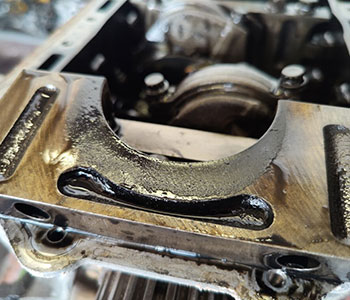
- Initial Assessment & Oil Analysis: Even before connecting diagnostic tools, a simple check revealed metallic glitter suspended in the engine oil on the dipstick—a clear sign of significant internal wear. We took an oil sample for reference.
- Electronic Diagnosis: Using our generic advanced OBD-II scanner (capable of reading manufacturer-specific codes), we retrieved multiple fault codes including P0528 (Fan Speed Sensor Circuit), often a secondary code triggered by overheating from excessive engine load, and various fuel rail pressure codes stemming from the engine's inability to crank evenly.
- Mechanical Confirmation – The Stethoscope Test: Using a mechanical stethoscope, we isolated the knocking noise. It was loudest at the oil pump and travelled through the block, not the cylinder head. This strongly indicated a failure in the rotating assembly (crankshaft, connecting rods, or bearings), not the valve train.
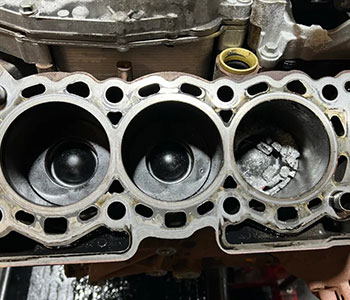
- Cylinder Contribution & Compression Test: A relative compression test via the scanner showed weak and uneven compression across several cylinders. A subsequent mechanical compression test confirmed low compression, likely due to poor ring sealing from distorted pistons or cylinder scoring caused by debris.
The Critical Factor Often Overlooked
A common response to a knocking TDV6 engine is to source and fit a second-hand engine. While this can be a solution, the fundamental cause of the original failure is frequently left unaddressed: oil flow and cooling system integrity. The TDV6 is known to be sensitive to oil degradation and coolant cross-contamination ("the dreaded chocolate milkshake" from a failing oil cooler). Installing a used engine without verifying the health of the oil cooler, intercooler, and full cooling system can expose the replacement engine to the same conditions that killed the first one.
The Root Cause Explained
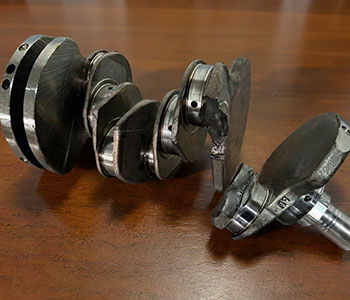
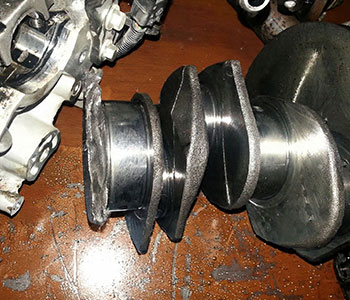
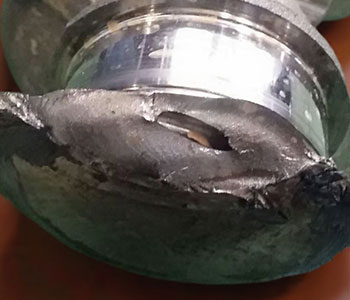
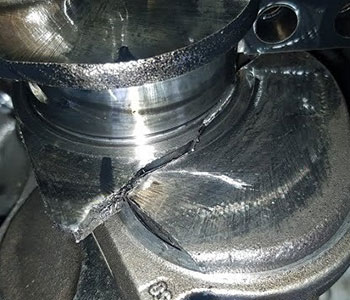
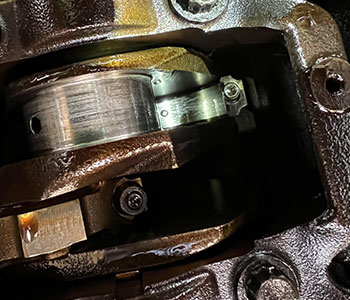
In this TDV6, the root cause was the catastrophic failure of the crankshaft's main and big-end bearings. This is typically a progressive failure. It often begins with oil starvation or the use of incorrect/infrequent oil changes, leading to bearing wear. As the bearing material wears away, clearance increases, oil pressure drops, and the crankshaft begins to "knock" against the bearing shells. This generates metal debris which circulates, scoring the crankshaft journals and cylinder walls. Eventually, a bearing shell can spin, severing oil feed and leading to complete seizure. Think of it like a main support beam in a house (the crankshaft) resting on worn-out, crumbled brackets (the bearings). As the brackets fail, the beam shakes violently, damaging everything connected to it.
Our Repair Strategy: The Most Comprehensive Solution for Long-Term Reliability
Faced with a confirmed bottom-end seizure, the owner has a narrow set of options:
- Second-Hand Engine Replacement: Swapping in a used engine of unknown mileage and history.
- Potential Outcome: Can return the vehicle to the road relatively quickly.
- Long-Term Consideration: A significant gamble. The used engine may have similar latent weaknesses, and the root cause (e.g., a marginal oil cooler) may not be addressed. Labour costs are high, and the core problem of the original design's weakness is not solved.
- Full Engine Reconditioning/Rebuild (Our Chosen Strategy): Completely dismantling the original engine, machining or replacing the damaged core components, and rebuilding it to a precise specification.
- Why This Was the Most Comprehensive Choice: This was the only strategy that allowed us to inspect, rectify, and upgrade every affected system. We could salvage and machine the original cylinder block and head (if possible), install a new or reground crankshaft, uprated bearings, new oil pump, and critically, replace the oil cooler and inspect the entire cooling system. This transforms the original failure point into the most robust part of the vehicle, offering predictable, long-term reliability.
Our Detailed Repair Procedure:
- Engine Removal & Stripping: The engine was removed and completely disassembled. The damage was comprehensive: multiple spun main bearings, a scored crankshaft, and debris throughout the oil galleries.
- Machining & Component Selection: The cylinder block was sent for specialist crack testing, cleaning, and honing. The cylinder head was inspected and reconditioned. We sourced and fitted:
- A reground crankshaft with undersized bearing journals.
- A matched set of performance-grade Vandervell or ACL big-end and main bearings for the undersized journals.
- A complete set of new OEM piston rings.
- A new Land Rover OEM oil pump and a new Genuine Land Rover oil cooler.
- A full gasket and seal kit (Elring or Victor Reinz).
- Precision Reassembly & Run-In: The engine was rebuilt with meticulous cleanliness. All bearing clearances were measured with plastigauge. Torque sequences were followed religiously. Once installed, the engine underwent a careful controlled run-in procedure to seat the new rings and bearings properly before returning to full service.
Results & "Before/After" Proof
- Noise: The deep engine knock was completely eliminated. The engine now runs with a smooth, characteristic diesel clatter.
- Performance: Full power and torque were restored. The excessive smoke cleared entirely.
- Oil Integrity: Post-repair oil analysis after 500 miles showed no abnormal metallic content, confirming a clean, healthy rebuild.
- Reliability: The vehicle was returned with renewed longevity, having addressed the systemic weaknesses that led to the initial failure.
Summary:
- Core Problem: Catastrophic failure due to spun crankshaft main bearings, leading to a seized bottom end.
- Solution:Full engine removal, reconditioning of the block and head, installation of a reground crankshaft, uprated bearings, and new ancillary components (oil cooler, pump).
- Outcome: A mechanically refreshed engine that exceeds original factory specifications in key durability areas, restoring dependable performance.
Verified Customer Review
— Andrew B., Derbyshire
“When the big ends went, I thought it was the end for my Disco 3. RR4x4 Works presented a clear choice: a gamble on a used engine or a proper rebuild that would last. Their explanation about the oil cooler and uprated bearings made the rebuild the obvious long-term decision. The process was transparent, and getting the old crankshaft and bearings back in a box showed exactly what had failed. It wasn't a quick fix, but it was the right fix. The car now drives better than it has in years.”
Read More ↑Concerned About a Similar Issue? Get a Professional Diagnosis
A knocking engine is a serious warning. Early diagnosis can significantly affect repair options and cost. If you hear unusual noises from your Discovery's engine, contact RR4x4 Works for an urgent and thorough assessment.
Get Free Quote Call 01708 556 721